
Over-the-shoulder
The desk where the design is made
A real Brightwell bench: keyboard at rest, mug set aside, one notebook open beside a monitor edge glow. The design system, wireframes, and Dev Mode handoff files are all made here.

© 2026 Brightwell Trading Group

Services · Boston systems studio
This page lists what Brightwell actually sells. Not a capability menu: each service below is a defined engagement with a deliverable at the end. If your need does not fit one of these, say so in an enquiry and we will tell you whether it is work we do.
745 Atlantic Avenue, Suite 410 · Boston, MA 02111
What this page covers
Every row below is work Brightwell has scoped, priced, and delivered: systems design, software design and product UI, design systems and component libraries, handoff and Dev Mode workflows, AI-assisted workflow integration, low-code and no-code builds, CI/CD and self-hosted tooling, platform selection, and retainers. Scope, sequencing, and pricing live on the process page.
Systems & integration
For teams whose product depends on more than one system talking to each other. We map the current architecture, name the constraints (hardware, data, compliance, vendor lock-in), and design the integration path. Boston clients with a mix of on-premise and cloud systems use this most, because the integration path is where the unknowns live.
Deliverable
A written systems design with the interfaces named and the risky assumptions flagged.
Product interface
Screen-level design for a product that has real users and real states. Wireframes, prototypes, and interface design that an engineering team can implement without a second interpretation. We work from the component level up, so a design decision made on one screen is a decision made everywhere that component appears.
Deliverable
A reviewed design set with states, edge cases, and empty states documented, not just the happy path.
Library & rules
A design system is a maintenance commitment, and we build it as one. Tokens, components, usage rules, and contribution guidelines, documented so a new engineer can add a component without asking a designer. Teams that already have a system but no adoption usually need this work more than they need a new system.
Deliverable
A library plus the written rules for changing it.
Design to code
Design files that reach engineering as guesswork cost more than they save. We set up handoff so specs, tokens, and component behavior travel with the file, using Dev Mode-style inspection workflows and naming that matches the codebase. This can be a short engagement on its own, and it is the one that most often removes a weekly meeting from a team's calendar.
Deliverable
Specs, tokens, and component behavior travelling with the file.
AI in the workflow
We place AI tools where they change a specific step: code generation and refactoring in the editor with Cursor, long-document analysis with Claude, drafting and summarization with ChatGPT, and enterprise in-app assistance through Microsoft Copilot. We do not recommend AI in a step where a deterministic tool does the job better.
Deliverable
An integrated setup plus a written rule for what still requires human review.
Low-code builds
Webflow and similar platforms are the right answer for a lot of marketing sites, and the wrong answer for a lot of product applications. We help you pick, then integrate what you choose with your existing systems so it does not become a parallel stack.
Deliverable
A working site or app with the content model, hosting, and handoff documented.
Deployment
Deployment should be repeatable and it should be yours. We set up build and deployment pipelines, and stand up self-hosted tooling where a team needs to keep design or code assets inside its own infrastructure. Penpot's self-hosting option is a common piece of this, as is a CI/CD pipeline that runs the same way on a laptop and on the server.
Deliverable
A pipeline plus the runbook for when it breaks.
Toolchain choice
For teams choosing a toolchain and needing a defensible decision. We compare the realistic candidates against your constraints (exportability, integration, governance, cost model, exit path) and write the recommendation with the trade-offs stated. Useful when procurement, security, and engineering all have to agree and nobody wants to own the call alone.
Deliverable
A written recommendation with the trade-offs stated.
After the build
After a build, some teams want us available for the next phase of changes. Retainers are monthly, scoped by hours and by what counts as in-scope, and include a named contact on our side. We do not use retainers to keep you dependent; the goal is that your team can run the system without us.
Deliverable
Scoped monthly hours, a named contact, and a path off the retainer.
What we will not sell you
We do not bill hours for work we have not scoped, and we do not start a build before the constraint list is agreed.

Our one rule
Brightwell Trading Group · Terms of engagement
Where the work happens
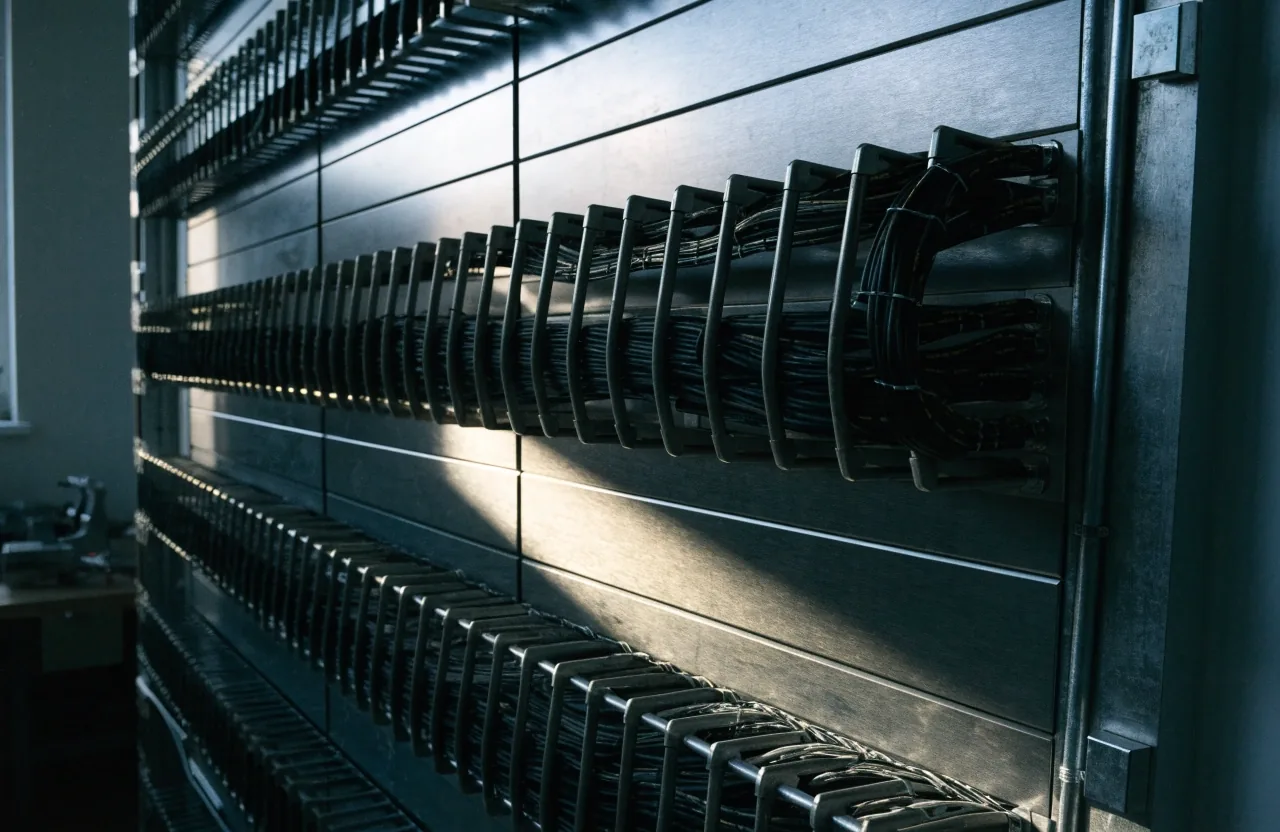
When a service above turns into a build, these are the rooms it happens in. Each piece of work lands in a workspace like one of these: a bay wall as a skin of rack hardware, a hand mid-run on the bench, a service wall dressed end to end. Look close at how a picture is made before you ask for one like it.
Over-the-shoulder
A real Brightwell bench: keyboard at rest, mug set aside, one notebook open beside a monitor edge glow. The design system, wireframes, and Dev Mode handoff files are all made here.
Rack wall
An anodized panel wall with cabling dressed into a loom. This is where self-hosted tooling and CI/CD infrastructure physically sits once the pipeline is set up.
At the keys
A hand at rest on the keys, cooled by a monitor edge. Every pipeline we ship has to run the same way on a laptop and on the server.

What we rule on
Every engagement starts with the constraint list: hardware, data, compliance, vendor lock-in, and how far the tool actually has to travel into your team. We write the trade-offs down and name the risky assumptions before anything gets scoped. A tool we would not recommend is still a tool we will tell you about, with the reason attached.
What that produces
What lands in your hands is a system, not a slide deck. Every engagement above ends with a written artifact (a design set, a library, a runbook, a recommendation) and the rules for changing it, so the work keeps going after we step back. Most retainer clients reduce hours within a year, which is the intended outcome.
Questions we get
Three questions come up on almost every enquiry. If yours is not here, the contact page is where to put it.
Ask about your projectYes. Handoff and Dev Mode workflows are scoped as a standalone engagement. Teams that already have a finished design file but no working path into production are the ones who use it most, and it is often the shortest engagement on this page.
Yes. Penpot's self-hosting model is one of the reasons we recommend it to teams with infrastructure requirements. If your security posture says design files and code assets stay inside your own infrastructure, we stand the tooling up there and hand over the runbook.
Discovery phases are the smallest thing we sell, and they are deliberately short. Larger builds start after that phase, not instead of it, so the constraint list and the risky assumptions are on paper before either side commits to the bigger number.
Next step
The enquiry goes to Laurent Beras directly. Mon–Fri, 9:00 AM – 6:00 PM Eastern. Email [email protected] or call +1 718 474 1511.